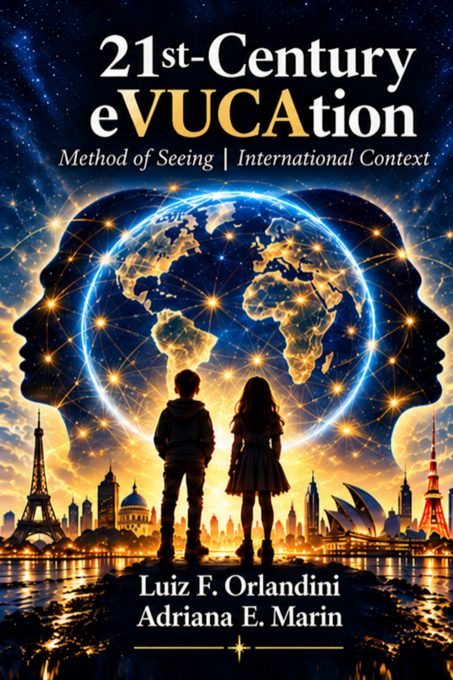
We live in a deeply interconnected world, where people, knowledge, technologies, economies, and cultures cross borders with unprecedented speed. In this context, education must learn to see what outcomes alone cannot reveal: trajectories, conditions, asymmetries, opportunities, and human potential.
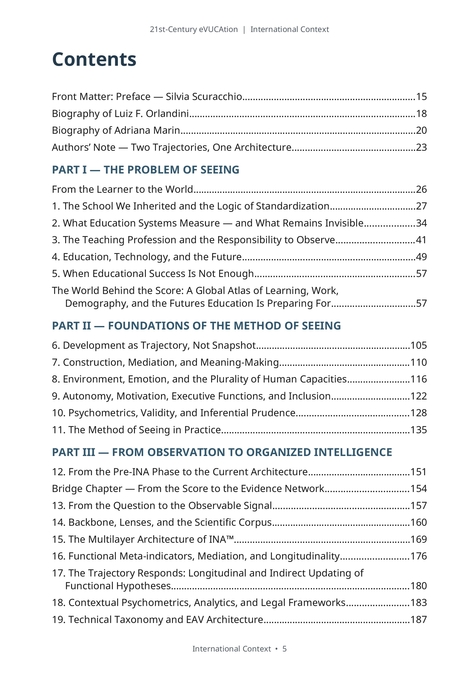
Expanded from the Brazilian Foundational Anthology, this International Context edition carries the Method of Seeing into a global inquiry. Luiz F. Orlandini and Adriana E. Marin examine how education, work, demography, technology, culture, and human development interact — and how similar results can conceal profoundly different realities.
At the center of the book is INA™ — Neuroartificial Intelligence, a human-centered interpretive architecture that organizes contextualized, longitudinal, traceable, and revisable evidence without reducing people to scores, labels, or automated conclusions.
Through a Global Atlas, the book asks not which country has the “best” model, but what each system’s strengths reveal — and what they may still leave unresolved. For educators, researchers, policymakers, universities, governments, and institutions, it offers a disciplined path from international evidence to contextualized inquiry, preserving local singularities while promoting more human, explainable, and responsible forms of intelligence.
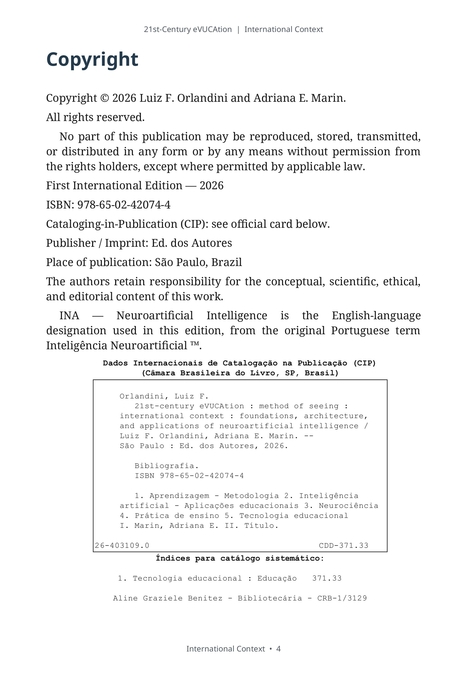
| ISBN | 9786502420744 |
| Número de páginas | 404 |
| Edición | 1 (2026) |
| Formato | 16x23 (160x230) |
| Acabado | Tapa blanda (con solapas) |
| Coloración | Blanco y negro |
| Tipo de papel | Offset 90g |
| Idioma | Portugués |
¿Tienes alguna queja sobre ese libro? Envía un correo electrónico a [email protected]


Haz el inicio de sesión deja tu comentario sobre el libro.